

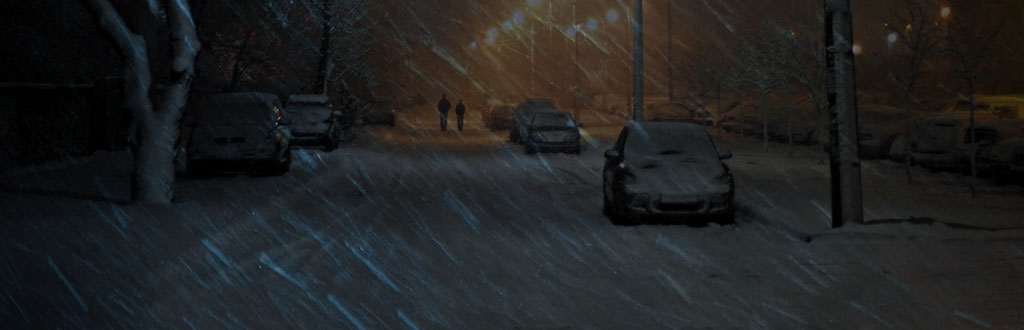
It was about six-thirty and already dark when they found Tanya Barrett trudging through the bone-chilling sleet precipitating what was expected to be the worst blizzard to hit the city in two decades. They had been searching for her for nineteen hours.
Hudson Avenue – all of downtown, in fact – was completely deserted. Despite the street lights, visibility was close to zero, and if he hadn’t been looking closely, Hawk surely would have missed the slight movement on the southwest corner of Hudson and Laurel.
“There,” he pointed. Nick pulled the car over carefully, skidding a little in the slippery slush. They were right behind her, but apparently, she hadn’t heard them drive up.
Hawk watched her for a moment from the car, noting her hunched posture and desolate expression as she stared unseeingly at the ground in front of her. She was shabbily dressed in a thin, faded sweatshirt, ripped jeans and pathetic canvas sneakers that were soaked through. He felt sorry for her; for her mother, her stepfather – for all the families trying to make it work when love was not enough.
Tanya was not one of Hawk’s chronic runaways. She was a first-time missing, and those always disturbed him the most, because he didn’t know what to expect or how to plan his search. What would this one fall into, out on the street: prostitution? drugs? Her mother had firmly rejected the idea that Tanya might be connected to a gang and though she didn’t know any of her daughter’s friends well, she was able to give the detectives the name of a boy Tanya had been hanging out with lately. After talking to sixteen-year old Angel Rios, Hawk was convinced Tanya wasn’t involved in any gang activity, yet. It gave him a modicum of hope that this missing might not be completely lost… if she was ever found.
Missings were a top priority for any squad. Unless a detective was directly occupied with an exigent rape or homicide, a missing took precedence over any other type of case. There was good reason for that, as those ubiquitous crime shows on TV accurately depicted: every hour that passed substantially diminished the chances of finding a missing child alive. There were so many unspeakable things that could happen in a very short time. Hawk had seen most of them.
On cases like these, as the hours ticked by, he was reminded of the scene from The Wizard of Oz, when the sand ran quickly through the hourglass and Dorothy wept for her aunt, the sound of her own frightened sobs compounding the terror. It was utter torture to imagine the whimpered cries of kidnapped children facing a real, live predator before he killed them, or worse. Hawk forbade himself to do so, for then it would be impossible to allow his children to leave his sight, to step out of the house, to live any life at all. He didn’t need to see movies like Traffic or Taken – his life was those movies, and the parts they never showed, also.
The moment he opened the car door, hard, icy sleet pelted his face, blurring his vision. His suit jacket was open and within seconds his tie and shirt were drenched. She looked up and saw him approaching her purposefully, a tall, red-haired, serious-looking man who could only be a cop. He could see her trying to decide whether to make a run for it. He called out her name, told her, “Don’t run,” and in that split second, she bolted.
It was slippery and her sneakers had no traction whatsoever, but she ran in the wild, desperate way of an adolescent who has no experience of the pain of falling to hinder her stride. When she felt him gaining on her and then saw him running beside her, she sobbed in frustration, but she kept going, unable to give up, spurred onward by the primal fear of capture. It took her a moment to realize that he was keeping pace beside her, but was making no move to stop her. The strangeness of it was both ridiculously funny and infuriating. She wanted to push him away from her, but knew the effort of it would slow her down.
They sprinted together, side by side, until Tanya slipped and stumbled. Long fingers encircled her arm to steady her. She felt the pressure, strength without force. They slowed down simultaneously until they came to a stop. Clouds of steam spurted from their mouths with every rapid exhale, like car exhaust sputtering from a reluctant engine. She stood, bent over with her hands on her knees, gasping in the cold air. Hawk could not tell from the sound she was making if she was crying or laughing; maybe it was a mixture of both. He straightened and brushed his jacket aside, momentarily revealing his badge as he panted out his introduction. He told her his name, adding, “But everybody calls me Hawk.”
She looked at him from the sides of her eyes. “How come?”
“Long story. But I was this close to being Big Bird instead, so I’m okay with Hawk.” She gave a tiny laugh, despite herself.
“Where were you going?” Hawk asked, casually, glancing up and down the deserted street. Nick had pulled the car up and was waiting a few yards away.
She stopped smiling and looked away. With her hands shoved into her front pants pockets and her shoulders hunched forward against the cold, she looked like a sad, little animal. “Nowhere,” she replied in a bleak, dejected voice, adding bitterly, “Where’s there to go?”
“Oh, there’re plenty of places you could end up.” Hawk paused. It was snowing heavily now, thick, wet flakes. They were both completely soaked. “You look cold. You wanna sit in the police car?”
She tensed immediately. “No. You go if you’re cold.”
Hawk was not cold. Or rather, if he was, then he liked the sensation. He never wore a winter coat on the job, nor hat, nor gloves. His colleagues marveled that he never got sick, but Hawk had a perfect attendance record. Certainly, there were times he felt under the weather, but even then he was too restless to stay home. Lying in bed for a whole day was unbearable, a punishment. He would rather be at work, where there was always a lot to do and he could be distracted from feeling lousy.
“I don’t get cold.”
“Never?”
“Nope.”
“You’re like my dad. He never gets cold either.” Instantly, the mood had shifted.
Hawk knew from her mother that Tanya’s disappearance had something to do with her father. “Where’s he,” he asked gently.
“Who the fuck cares?”
Hawk could tell from her unnatural delivery that she was unused to swearing. Perhaps she was testing its shock value. It had none. “Mmmm.”
“What’s that supposed to mean? Oh, I bet I know what’s coming next. You’re going to tell me that I shouldn’t say things like that, that I’ll regret it later, and blah, blah, blah.”
“No. It’s not for me to judge how you feel about anything.”
“Yeah? That’s that bullshit childhood psychology, right? I know you’re here to take me back and I know what you’re thinking: you’d rather be home in your nice house with your nice family rather than chasing down some screwed up kid in the middle of a snow storm. You all think I have nothing serious to worry about ‘cause I’m just a kid and you’re the know-it-all grown-ups. But you don’t know anything!” She was shouting now. “You don’t know me. Nobody knows me. Why don’t you all just leave me alone? I don’t want you here. Even I don’t want to be here. I hate it here. HERE, on this fucking planet!” She was crying, furious tears, which she batted away violently, ashamed of crying in front of a total stranger.
He did not take his eyes from her face. Very quietly, without any mockery, he asked, “What’s the alternative?”
“I don’t know,” she yelled and threw her arms out wide. At the top of her lungs she shouted toward an invisible sky, “I DON’T KNOW!!!” She looked to see if he was laughing at her or wearing the typical, condescending, adult face. He was doing neither. He was just standing there, in the freezing, wet, miserable snow, this man with no coat, acting like he had all the time in the world to just listen to her.
“How am I supposed to know,” she shot at him. “I’m a kid. You’re the grown-ups. You’re supposed to take care of us!”
“You’re right,” he said.
“Yeah? Well, nobody’s doing that these days.”
“I’m sorry.” He said it simply, softly, utterly genuine.
“Well, you’re not the one who’s to blame.”
“I’m sorry anyway.”
“That doesn’t help.”
“What will?”
She stood there, shaking with cold, hesitating, knowing that to say it out loud would probably just make it hurt even worse than it did already, but needing so badly just to tell someone. Hawk waited patiently, as she struggled between distrust and her desire to confide in him.
“I want my father back.”
A long moment passed before Hawk answered, “Yeah, I know how you feel.”
A confused, shockingly mature look crossed her face, and she asked, “Yours walk out on you, too?”
“In a way.”
“What does that mean?”
“He died.”
“Oh. When?” She didn’t know if she was allowed to ask that. She’d said it tentatively, prepared for him to tell her it was none of her business. That’s what grown-ups did when they didn’t feel like answering. Funny, but they had no problems asking her personal questions.
“When I was a kid,” he answered. “A bit younger than you.”
“Was he sick?”
“Nope.”
“How’d he die?
“Someone killed him.” That was more than he had told most people over the course of his entire career.
She did not meet his eyes when she said, “Sorry.”
He shrugged. “What’re you gonna do?”
Her teeth were chattering now as she said, “Well, mine’s not dead. But he might as well be.”
“Where is he?”
“Detroit.”
“Oh. That’s pretty far.”
She eyed him sharply. “I wasn’t going there, if that’s what you think. He doesn’t want me.”
“Why do you say that?”
“Well, he says he wouldn’t want to keep me away from my mother, but I don’t believe that crap.”
“Why not?”
“Because, if you want somebody, you don’t leave them.”
Hawk felt a burn behind his eyes. She was so young, he thought. He tried to remember a time when things seemed so simple to him, when the world was that black and white. He couldn’t. This was always the dilemma with his teenage runaways: did you treat them like adults, sparing no detail of the harsh realities of life, or did you try to protect them, preserve the last shred of innocence they wore so nakedly on their faces? He thought of what he’d want someone to say to his own girls if, God help him, one of them was standing out here in the cold after nineteen heart-stopping hours of being missing. It would never be one of his own, he vowed. He would never get so far away from them that someone else would be having this conversation with them. Suddenly, he was filled with a fierce, hot need to hold his children, to assure them that no matter what might be happening between him and their mother, he would never, ever leave them.
“There are some things that might make a father give up his child,” he lied. Before she could ask, “Like what?” in her skeptical, yet childishly hopeful way, he said, “He must think good things about your mother to be willing to leave you with her.”
She answered back immediately, but Hawk could tell that she was thinking about what he had said. “I don’t know about that. They fought all the time. Now she fights with me all the time. I swear, sometimes I just… I just hate her.”
“Everybody feels like that at times.”
“Did you?”
“What? Hate my mother? Not really. But, after my dad died, I felt guilty for doing anything she didn’t want me to do, or thought was too dangerous. Then I’d be mad that I had to feel guilty in the first place and I’d take it out on her by doing even stupider things, or ignoring her. That was worse, because I could tell she was hurt and worried and then I’d feel even guiltier than before. It wasn’t easy.”
“Yeah.” There was a long silence as she stared at the ground, absorbing his words, trying to work things out in her head. Finally, pretending indifference, she said, “I guess we could sit in the car now. If you want.”
Hawk suspected she must be freezing. Teenagers fascinated him. Parts of their brains were so undeveloped, like their judgment, or impulse control, or their capacity for self-preservation. He was amazed so many actually survived adolescence. On the other hand, their emotional lives were so complex, so raw and passionate, that dealing with them was like navigating a minefield. It was a constant source of wonder to him that adults had any control over them at all. It was an illusion, Hawk knew, contrived as a result of years of being small and helpless, conscious only of their powerlessness against the authority figure, that kept teenagers believing their parents still had power over them. In truth, there was no power but that which the child perceived, accepted, allowed. Like some mysterious, unspoken contract, it seemed a virtually unchallenged law of nature that made the strong youth cower before his weakening father. This phenomenon never ceased to amaze Hawk. Sometimes he found himself wondering what his relationship with his own father would have been like if he hadn’t been killed.
When they got in the car, Hawk in the front passenger seat, Tanya in back, he introduced her to Nick.
“My crazy partner here keep you freezing out there this whole time?” Nick’s blue eyes twinkled merrily as they met hers in the rear-view mirror. She gave a small smile. His charm was hard to resist. “I don’t know why he’s called ‘Hawk’ when he’s a freakin’ penguin.” Hawk turned in his seat to grin at her, rolling his eyes.
“Where to,” Nick asked, casually. “The station house, or home?” Hawk said nothing, letting Tanya know it was her decision.
“Not home. Not yet,” she said.
Nick drove them to the precinct, stopping first at the McDonald’s drive-thru. The partners had this part of the routine well-synchronized, though it was sadly too infrequently that they got to give a missing their special, royal treatment a la NYPD.
Back at the precinct, Tanya followed Hawk around, like a sad, skinny shadow. Nick, who had telephoned her mother the minute Hawk caught up to her on the street, called again and asked her to give them an hour or so before they brought her home. Despite the snow storm, her mother insisted on coming to the station to pick Tanya up herself, but she agreed to wait an hour.
Tanya sat shyly next to Hawk as he typed up paperwork at his desk. She made eye contact with no one else, and none of the detectives tried to engage her in conversation. Outwardly, they pretended it was just an ordinary evening in the Eight-two, and that they didn’t even notice the silent, soaked fourteen-year old wrapped in an old, scratchy towel sitting next to Hawk. But inwardly, the entire squad was enormously relieved that she had been found. There were so many failures, after all, and those were horribly difficult to recover from.
Hawk was comfortable with silence, and he didn’t push her to speak. The few times she did, he answered her honestly, naturally, as if they had known each other a long time. He knew she just needed to be close to someone and he understood her temporary attachment to him. She seemed very small and vulnerable, huddled beside him in the big, black chair, but she was stronger than she looked. He had a good feeling about this girl. He would bet money she was going to make it, that she wouldn’t become one of his chronic runaways, or, heaven forbid, one of his never founds.
An unbidden memory popped into his mind while he sat there, of another young girl, found three months after she disappeared, thrown away like some piece of garbage. He had torn open the black plastic bag to reveal her broken face, contorted in death, track marks and cigarette burns and bruises from repeated sexual abuse tattooed forever onto her thirteen-year old skin.
Suddenly, like a fast-moving slideshow, a thousand images flashed through his head, parents holding photographs of children smiling at the camera, pushing them toward him like jewels, showing him, begging him, if only he could find this one precious child… He was startled to realize that he was praying.
When her mother came to get her, Tanya was resigned, if not entirely ready to go. Hawk walked her silently to the door and watched as mother and daughter stepped out into the freezing, blustering, unwelcoming night, thinking there was so much hard work for them ahead, but perhaps a new understanding, as well.
She turned once to look at him over her shoulder, gazing at him for a long moment before turning back into her life. Then she patted her side pocket, where she’d put her phone, and Hawk understood she was telling him that she would use the number he had given her if things got too bad. He hoped she never had to.
* * * * *
The phone rang three times before his wife picked up, sleepy, but instantly wary. “Hello?”
“It’s me. The girls okay?”
“They’re asleep. Why? What’s happened?”
He heard the fear in her voice; it was there all the time now. Had it always been there, and he’d just never noticed?
He did not attempt to talk to her about his day. It had been a tacit understanding between them, almost from the very beginning, that she preferred not to know about the realities he encountered every day, and he made every effort to shield her from that harsh world that frightened her so much. It was kind of like leaving muddy boots outside the door. Only, Hawk lived in that world. He loved that world. It was so deeply a part of him, he could no more imagine a civilian life than one in a wheelchair.
He found that he was staying later at the precinct these days, putting off going home where the atmosphere was always tense and nothing got said because neither of them said it.
He sighed into the receiver. “Nothing’s happened. Everything’s fine. Just checking in. See you when I get home.”
“Alright. Goodnight.” She hung up.
He closed his eyes. Pressing the receiver against his neck, he whispered, “Maybe we could just…” He could not name his wish.